
Monthly Archives: August 2013

Grumpy Cat Products

3


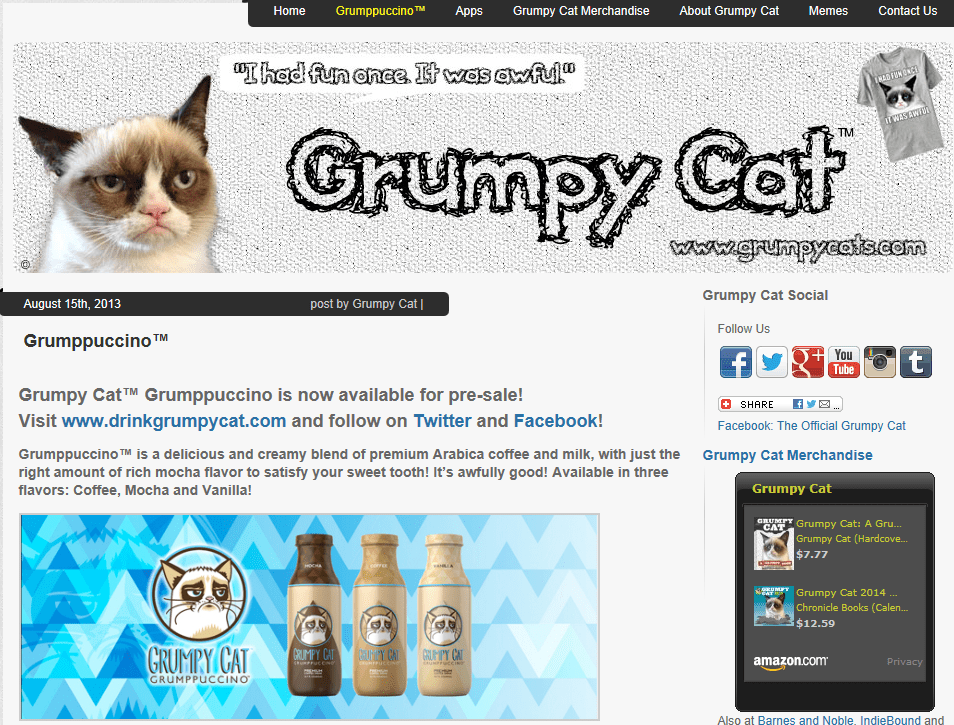
“I had fun once. It was awful.” This is the essence of Internet sensation Grumpy Cat, a feline who has an opinion (usually negative) about lots of things in the world. Grumpy Cat had her launch on YouTube in 2012 and it’s been uphill ever since with more than 12 million views!

Videos may have launched Grumpy Cat, but the savvy Web site continues to add content and merchandise. Fans of Grumpy Cat buy tee-shirts, mugs, key chains, magnets, books, and calendars from the Web site. But why stop there? What other products should Grumpy Cat endorse? While cat food might be a logical choice, Grumpy Cat has chosen another direction for now.

Well, lack of sleep often makes people (and cats) grumpy, so fans of the frowning feline can now buy Grumpy Cat Grumppuccino, a blend of premium Arabica coffee, milk, and flavor (coffee, mocha, and vanilla).  We’re not sure if this new product will make Grumpy Cat smile, but it sure expands the branding of the famous feline.

Group Activities and Discussion Questions:

  1. Discuss branding and product extensions.
  2. When are product extensions a good idea? When are they not a good idea?
  3. Poll students about Grumpy Cat and show the Web site: http://www.grumpycats.com/
  4. Show Grumpy Cat video: http://youtu.be/INscMGmhmX4
  5. Who is the target market? What are the products/services offered?
  6. Divide students into teams. Have each team list all of the brand extensions they can think of (e.g., Coke, Pepsi, etc.)
  7. Have each team select a brand and product. Then have each team develop a product extension.
  8. Who is the target market? Determine the 4Ps – product, price, distribution, promotion.

Source:  Brandchannel.com, 7/30/13
Leave a comment

Filed under Classroom Activities

Target’s Bullseye University for College Students

2

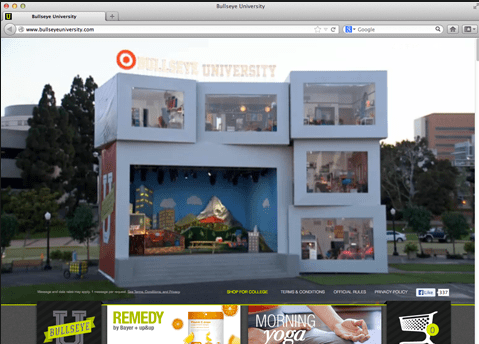
It can be difficult for companies to reach Millennial shoppers. The media and Internet-savvy generation can be skeptical of marketing claims, preferring to use their own eyes and contacts to decide on purchases. This generation is used to shopping, living, communicating, and doing virtually everything online. Companies that want to reach this target market cannot depend on drawing them to their stores, but instead need to go directly to where the market lives. So, Target decided to go to the college students on their own turf and set up a four-day shoppable event featuring five popular YouTube personalities living in “Bullseye University” dorm rooms. From July 15 – 18, the five ‘students’ lived in a fishbowl and acted out college life scenarios.

To run the event, Target constructed a college dorm in Los Angeles to show off its back-to-school products and get young shoppers interested in the store’s offerings. In the custom-designed dorm rooms, five social media celebrities –  Chester See, Meekakitty (aka Tess Violet), Magic of Rahat, Jenn Im of Clothes Encounters, and Brooke “Dodger” Leigh – became dorm-mates with a live video stream of their actions and interactions with the public. What was in their rooms? Target’s products, of course. By scrolling over the rooms, and clicking on the various rooms and items, viewers could interactively shop and purchase items directly from the site.

If it sounds a little like MTV’s Real World, it does have similarities as Target attempts to penetrate the digital universe of university students. Target wanted to move beyond commercials and ads and focus on the tactics that resonate the most with younger shoppers.

Is it worth it? Yes. The National Retail Federation estimated that back-to-college spending will yield $45.8 billion in sales, second only to the Christmas shopping season.  The average spending for dorm rooms will cost students an average of $104 on bedding, appliances, and supplies. Welcome back to school!

Group Activities and Discussion Questions:

1. Start with a discussion about shopping for supplies as a university student.

2. Poll students: What did they buy for returning to college? How much did they spend? What influenced their purchases?

3. Next, show the Target site and videos: http://abullseyeview.com/target-video-bullseye-university-back-to-college/

4. Divide students into groups. Have each group discuss how similar promotions could be developed for other milestones and special shopping occasions. (Ex: Weddings, births, birthdays, holidays, etc.)

5. Have teams define the target market, product mix, and how to promote the shoppable events.

Source:  Minneapolis Business Journal

Leave a comment

Filed under Classroom Activities

PR: Toothbrush Swap Swamps London

1

Public relations can be an excellent tool for promoting a new product and getting the consumers’ attention, but sometimes it can backfire. This was the case with Colgate’s Electric Tooth Brush swap event launched in London’s Waterloo Train Station this summer. The event promised consumers that they could swap an old electric toothbrush for a new Colgate toothbrush priced at $256.

The offer got plenty of attention, but perhaps it got too much attention. By 5:00 a.m., hundreds of eager people had swamped the rail station, holding their old toothbrushes and looking for the new freebie brush. The problem: Colgate had only brought 750 of the new brushes and ran out of supplies in the first few hours!

Unfortunately, since marketing is now in the age of Twitter and instant communication, the fiasco was publically followed by thousands of Londoners throughout the day as the company tried to mend fences and meet demands. Colgate’s competitors also entered the fray with Phillips comparing its own electric toothbrush in print ads and offering its own  promotion swap for Phillips’ Sonic Care electric toothbrush.

In the end, Colgate revised the promotion to be online, giving away 7,000 new electric toothbrushes to eager consumers.

Group Activities and Discussion Questions:

  1. Discuss the use of public relations as a marketing tactic. What are the pros and cons of using PR?
  2. View the Colgate video: http://youtu.be/qHGi3cjw4RM
  3. Discuss what happened in London for Colgate? What were the major flaws in the program? How could the program have been run smoother?
  4. Divide students into teams. Have each team select a common household product such as toothpaste, broom, soap, etc.
  5. Then, have each team develop a possible PR event to draw consumers. Have students define the marketing mix as well as identify the target market for the campaign.
  6. What are the main planning considerations?
  7. How does social media tracking, such as Twitter, impact marketing activities? What should companies do to maximize Twitter during such events?

Source:  Brandchannel.com, 7/16/13

Leave a comment

Filed under Classroom Activities