
Monthly Archives: September 2012

This Month’s Viral Videos

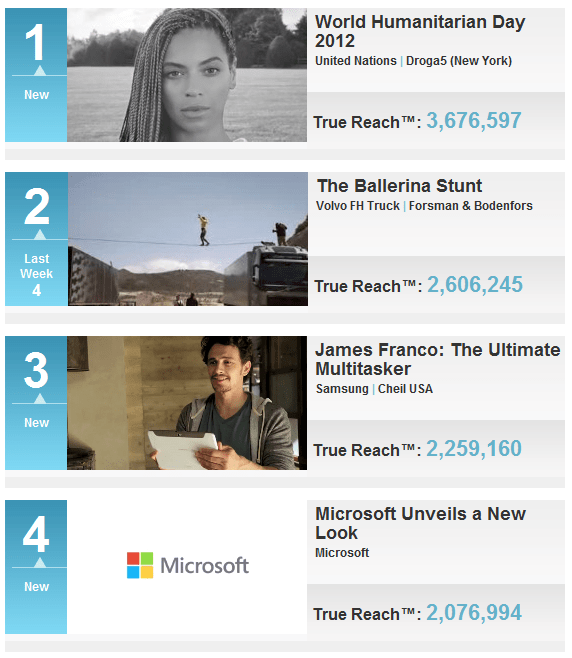
Every week Advertising Age, in conjunction with company Visible Measures, publishes a list of the week’s top performing videos. The weekly chart highlights viral video ads that appear on online video sites. Each ad measures viewership of brand-syndicated video clips as well as social video placements that are driven by viewers around the world. (A measurement called True Reach™ quantifies the total audience that has been exposed to a viral video campaign. The measurement combines data from brand-driven seeded video placements with results from community-driven viral video placements – spoofs, parodies, mashups, and more.)

There are three key factors for viral video success:

  1. Reaching the tastemakers.
  2. Building a community of participation.
  3. Creating unexpectedness in the video.

Regardless of the type of product or service, the country of origin, or the importance of the message, what matters is reaching the audience in a way the both entertains and informs.

Check out this week’s top videos and discuss what makes them “viral” – http://www.visiblemeasures.com/adage

Group Activities and Discussion Questions:

  1. Bring up Ad Age’s weekly Viral Video chart: http://www.visiblemeasures.com/adage
  2. Have students examine how the ads are measured by Visible Measures.
  3. Divide students into teams. Have each team select an ad on the top video chart and analyze the ad.
  4. What is unusual?
  5. Who will it interest?
  6. What is the key message?
  7. How effective is the ad at getting the company’s brand and message across to viewers?
  8. In teams, have students design a viral video for a product of their choosing. What are the elements that are needed to go viral?

Source:  Advertising Age – weekly update each Thursday morning

Leave a comment

Filed under Classroom Activities

Nike’s Neon Shoe

The 2012 Summer Olympics posed a tricky question for sponsors: How could they promote their products without being an official Olympic sponsor? Since the official sponsorships cost in the multi-million dollar price range, it left many companies with few options for promoting their products during the athletic events. This could have been a tough issue for Nike, considering that although it was not an official sponsor,  nearly 3,000 of the Olympic athletes wear Nike products on and off field.

On top of the sponsorship restrictions, the IOC’s ‘Rule 40’ also prohibited the use of social media for promoting non-Olympic sponsors. Finally, in order to promote and protect the official sponsors of the London Olympics, the International Olympic Organization also prohibited athletes from appearing in advertising shortly before and during the Olympic Games.

How did Nike handle these restrictions? They used the marketing assets that belonged to them alone, their famous “swoosh” logo. The company started its planning long before the Olympic games opened. Using data gleaned form focus groups of athletes, Nike developed a unique new shoe color of a vivid neon green/yellow color and named it the Nike Volt. The color is very visible to the human eye, and Nike tested the color against the many different environments in which the shoe would be seen during the games – the red of the track surface, the blue and white of the fencing arena, and even the black of the boxing ring.

Nike calls the new hue a “signature color” (think “Tiffany blue”) and simultaneously rolled out the new color on shoes on the Olympic athletes as well as on their commercial Flyknit marathon shoe. The result gave Nike a visible platform to showcase performance of the athletes and its products.

Group Activities and Discussion Questions:

  1.  Poll students: How many watched the summer Olympics? How many of them noticed the Nike neon running shoes during the races?
  2. What other products can the students recall from the athletes wearing apparel? (Note: Beats by Dr. Dre used a similar ambush marketing strategy by giving away its headphones to hundreds of the Olympic athletes.)
  3. What was the business problem that Nike faced?
  4. What types of marketing research could the company use to solve the problem? (Note: Exploratory, descriptive, causal, etc.)
  5. How did the company maximize its Olympic exposure with the rest of its product marketing?
  6. Divide students into teams and have each team select an athletic product. Have each team develop an “ambush” marketing strategy that the company could use to promote products.

Source:  Ad Age Daily, 8/21/12, Brandchannel.com, other news sources

Leave a comment

Filed under Classroom Activities

What’s on the Students’ Minds?

Different generations have radically different experiences and context for their lives. And, these experiences can have significant implications for marketing professionals. Example: do today’s college students know what ‘card punch’ equipment was? How about listening to music using vinyl ‘albums’ instead of digital files?

To help highlight and understand the differences between generations, every year since 1998, Beloit College (Wisconsin) has assembled a list of cultural items and topics that have shaped the lives of new college freshmen. Beloit’s Mindset List was originally created to help its faculty become aware of dated references that might confuse students (or make faculty seem like they are totally out of date).

For example, the class of 2016 (born in 1994) does not take pictures on ‘film’ nor do they watch movies on ‘tape’. These students have always been in ‘cyberspace’ and they have never seen an actual paper airline ticket. Women have always been airline pilots and flown space shuttles. Students watch TV anytime, but very rarely do they watch shows on an actual television set at its scheduled time. They get their news not from news shows, but from YouTube. They do not know that Bill Clinton was President of the United States, but they do know that Hillary Clinton is Secretary of State. They read e-books, but find bound copies of the Encyclopedia Britannica as useless. History has its own television channel, and the Twilight Zone is about vampires, not Rod Sterling.

Check out Beloit’s list and see which of the list’s items might hold implications for companies in product innovation and marketing.

Group Activities and Discussion Questions:

1.      Review the Beloit Mindset list: http://www.beloit.edu/mindset/2016/2.      Divide students into groups. Have them list the most popular items in areas such as: movies, music, art, television, sports, etc.
3.      Then have the teams research what the leading products in these areas were 20 and 30 years ago.
4.      What are the implications for marketing products to the different generations? How do companies adapt products and marketing to reach across generations?
5.      How might a company take an older product (such as vinyl albums) and update it for relevance to today’s college student market?

Source:  Beloit College, various news sources, 8/2012

Leave a comment

Filed under Classroom Activities