
Monthly Archives: September 2012

Innovation and Design for Outcomes

Marketers often speak about the importance of design and innovation for new product development. Think about the products designed by Apple, Hewlett-Packard, Samsung, and more. Beautiful designs coupled with easy-to-use functionality are what we think of when considering innovative design.

But is the design the only thing that matters? Does every product that has won design awards and accolades achieve success in the marketplace? Unfortunately, no – innovative design does not translate into market acceptance, or even a good product.

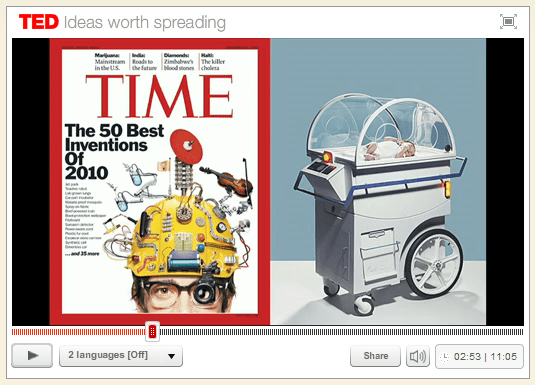
In this TED Talks video, Timothy Prestero (the founder and CEO of Deign that Matters, a nonprofit organization that works with entrepreneurs on products for developing countries) discusses his own experiences with product innovation geared for developing countries. Prestero candidly discusses his experience developing an infant incubator for developing nations – a product that won TIME Magazine’s “50 Best Inventions of 2010.”

Beautiful design – yes. Practical product implemented in hospitals – no. The lesson for innovators and inventors is that good design needs to focus on who will use the product – as well as all the ways that the product can be used incorrectly. As Preston said in his talk, “There’s no such thing as a dumb user; there are only dumb products.”

Group Activities and Discussion Questions:

  1. View the 11 minute video at http://www.ted.com/talks/lang/en/timothy_prestero_design_for_people_not_awards.html
  2. Discussion question: Ask students their opinions on what makes for a good product design? What is important in product innovation?
  3. In teams, have students develop a research plan for designing a new product for an industry of their choice. Use these industries as suggestions to get them started: healthcare, automotive, television, foods, clothing, air travel, transportation, candy, soft drinks, etc.
  4. How should the use research be conducted?
  5. What are other implications of the design process? Who should be consulted and included in the process?
  6. Discuss the concept of “design for outcomes.” What are the implications of this statement?

Source:  TED Talks, other news sources
Leave a comment

Filed under Classroom Activities

The Importance of Packaging

Although packaging might not be one of the classic “4Ps of marketing,” marketers know that packaging is an integral part of the product and promotion. Companies do continuous research to determine the optimum graphics, words, logos, and sizes in order to gain consumers’ awareness and eventual sales. In essence, the package becomes the product and provides the consumer with his first look and emotional appeal of the product.

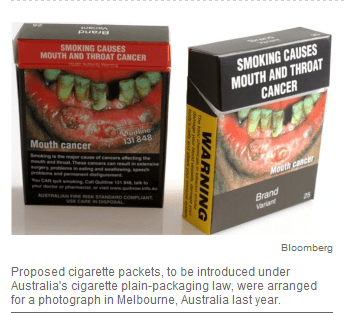
What then happens when the package design is not only removed from the manufacturer’s control, but is also made to be as realistic – in the case of cigarettes, unappealing – as possible? The result for tobacco companies is a dramatic package that clearly illustrates the drastic after-effects of smoking cigarettes.

In a recent ruling by the High Court of Australia, the law requires that cigarettes be sold in packages without any company logos, and with the same font for all brands on a dark brown background. In addition, 90% of the package back and 70% of the package front will have graphic health warnings about cigarette smoking. Plan packaging is a significant threat for companies as they will no longer be able to try to differentiate products from competition, and no longer be able to portray cigarettes as an attractive life-style choice.

Why such a drastic move by the Australian courts? The country’s government faces more than $31 billion in annual health care costs form smoking and estimates that smoking killed more than 900,000 Australian citizens over the past 60 years.

Group Activities and Discussion Questions:

  1. Discuss the importance of packaging for consumer goods products.
  2. Divide students into teams. Have each team use laptops to research the packaging and messages used by tobacco companies.
  3. Have students team research the tobacco packaging laws in countries such as the U.S., Canada, Australia, New Zealand, and the U.K.
  4. What are the ramifications of the laws for tobacco companies?
  5. Poll students: What are attractive packages that they can recall? What are unattractive packages that they can recall?
  6. Discussion topics: What are the ethical implications of tobacco advertising? Where is the line between legal compliance and ethical conduct?
  7. Research for students: How much do tobacco companies spend on advertising and promotion each year? How much is the health care cost for different countries?

Source:  Ad Age Daily, Bloomberg News, 8/11/12

Leave a comment

Filed under Classroom Activities

Augmented Reality for Mobile Phones

Augmented reality is more available to consumers than one might think. But what is augmented reality? In essence, it is the process of using technology (this time through a smartphone) to add different layers of information to what we see. Using the software for image recognition (on a smartphone) triggers an augmented reality video for the user.

One software product – Aurasma – uses a smartphone’s camera and apps to add “auras” (such as 3D images, games, and animation) on to real-world places and things. What is Aurasma? Available on smart devices, Aurasma uses technology that is capable of recognizing images, symbols and objects in the real world and understanding them. It can then deliver digital content in real time, including videos, animations, audio or webpages.

This TED Talks video, featuring Matt Mills and Tamara Roukaers of Aurasma, illustrates the power and reach of the new technologies. They demonstrate how using the application can add new insights and meaning onto the world around us. By pointing a smartphone at an image, the application can overlay (an aura) over the image and bring it to life using additional information. The video illustrates the use of the application with static images. An example is bringing a newspaper Wimbledon tennis story to life by overlaying videos on the static image. By pointing a phone at a movie poster, a video trailer can be launched; pointing at a building brings up an interactive map.

Watch the TED video and consider the applications for new product development and marketing tactics.

Group Activities and Discussion Questions:

  1. Show the video from TED Talks: http://www.ted.com/talks/lang/en/matt_mills_image_recognition_that_triggers_augmented_reality.html or from YouTube at http://youtu.be/frrZbq2LpwI
  2. Have students look up additional information on the company Web site: http://www.aurasma.com/
  3. Have students with smartphones download and try the application. Then have them share their experiences in class the next day.
  4. What are the implications of this technology for marketing of products and services?
  5. How can this technology be applied in marketing a product?
  6. How can consumers use the technology to improve or enhance their experiences?

Source:  TED Talks, other news sources

Leave a comment

Filed under Classroom Activities