
Tag Archives: Starbucks

Starbucks’ New Brew: Stirring Up the Service Model is Working

Pumpkin Spice Latte season is finally here and this year your coffee will be served with an extra shot of friendly service. When you think of Starbucks, you probably think of coffee. But according to CEO Brian Niccol, the company’s secret ingredient isn’t the latte, it’s the service. His bold claim? Starbucks’ goal is to become the “world’s greatest customer service company.”

That might sound surprising for a coffee chain, but it’s a powerful lesson in marketing strategy. Coffee is a commodity – a product you can get almost anywhere – often cheaper and sometimes better. What you can’t get everywhere is the personalized experience Starbucks is now doubling down on.

The company has rolled out its “Green Apron Service Model,” which trains baristas to focus on connection: greeting customers by name, handing off drinks with personal touches, and creating small but memorable moments. This approach reframes Starbucks from just a coffee provider to a premium service brand. In other words, Starbucks isn’t only selling hand-crafted drinks, it’s selling an experience.

Competitors like Dutch Bros and Luckin Coffee are betting on speed and price. Starbucks, on the other hand, is betting customers will pay a premium for human interaction, comfort, and a sense of belonging. Niccol is even investing hundreds of millions into training, store redesigns, and extra staffing to make this strategy work.

Starbucks is trying to win not through cheaper prices or even fancier products, but by making you feel seen, remembered, and valued. For marketers, it’s a case study in how service strategy and customer experience can differentiate a brand even if the product itself may be ordinary.

Discussion Questions and Activities

  1. Why is Starbucks focusing on service in addition to its premium products?
  2. How does customer experience create value that justifies premium pricing?
  3. What risks might Starbucks face in standardizing barista behavior through scripts and training?
  4. How do competitors like Dutch Bros highlight different service strategies?
  5. Have students check out this short video from Starbucks CEO Brian Niccol on how the coffee chain’s “back to Starbucks” strategy is boosting loyalty and engagement. https://www.instagram.com/reel/DMtOp_DpxlU/
  6. Customer Journey Mapping.  Students map the Starbucks customer journey and highlight where service interactions add value. Additionally, students research and map Dutch Bros or Luckin Coffee’s service strategy and present how it differs from Starbucks’ premium approach.
  7. Poll Students. Conduct a poll asking students if they are light users, moderate, heavy or brand advocates of Starbucks. Are they heavy users and advocates fans of the brand due to its products or the customer experience?
  8. Role Play. Pairs of students act out a Starbucks barista-customer interaction, one using a scripted model and one using improvisation. Compare which feels more authentic.

Sources:

Aten, Jason (13 Sep 2025) With Only 5 Words, Starbucks’ CEO Revealed Its Secret Ingredient (And It’s Not Coffee), Inc. Haddon, Heather (19 Sep 2025) Has Your Starbucks Barista Been Acting Especially Friendly Lately? Here’s Why. Wall Street Journal.
Leave a comment

Filed under Classroom Activities

Starbucks in China

7

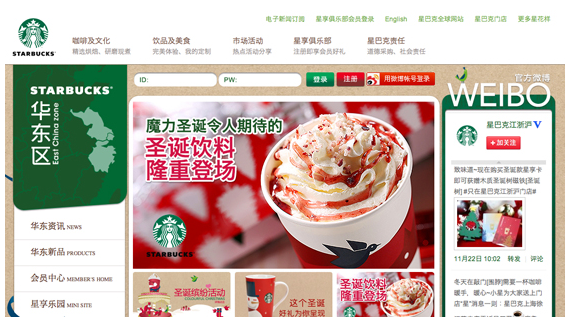
China is too big a market for U.S.-based companies to ignore. While it presents a very different culture – along with marketing challenges that accompany that culture – many companies have been working hard on expansion into the growth market. Among the companies working on reaching China’s 1.3 billion consumers is Starbucks. With 700 stores already in place, the company has been in China for 13 years and is about to ratchet up its efforts to get the Chinese people embrace its products. Starbucks plans to double its store-front locations to 1,500 in the next three years and the company expects China to become its second-largest market by 2014.

Although coffee sales increased 20% in 2011, China is not known for its coffee consumption. Starbucks has been adjusting its menu to carry more tea drinks as well as local food items such as Hainan chicken and rice wrap, shredded ginger pork panini, and red bean frappaccios.

In addition to food changes, the company also has to address cultural issues in China. For example, while the U.S. has a “grab and go” mentality to coffee, Chinese customers tend to linger for hours over food and drink. Starbucks is viewed as a place to socialize; most Chinese visit in large groups or pairs, requiring larger community tables, couches and armchairs. Starbucks’ baristas also need to teach customers about the products and drinks.

Group Activities and Discussion Questions:


  1. Discuss the need for U.S. firms to expand into new global markets.
  2. What attributes do companies need to successfully navigate different cultures?
  3. Divide students into teams. Have them examine the U.S. offerings from Starbucks.
  4. Next, have teams develop a marketing research plan for examining Chinese customs and tastes.
  5. Finally, what should a Starbucks store in China look like? How should employees act?
  6. Discuss key issues that need to be handled with international expansion.

Source:  Wall Street Journal, Ad Age Daily, Brandchannel.com, other news sources

Leave a comment

Filed under Classroom Activities

Jamba Juice mixes it up

Healthy drinks, and energy drinks, are the latest upward trend in the beverage industry. As a prime example of this push, California-based Jamba Juice is no longer content to be sold in stand-alone stores, grocery stores, and convenience stores, and is now expanding its presence into schools. The company is adding its smoothie machines and know-how to promote healthier options for students dining. The company is testing kiosks in 30+ elementary and secondary schools, and plans a major push into more U.S. schools by year-end.

Jamba Juice is also expanding beyond its traditional strengths in smoothies by adding oatmeal, flatbreads, and teas to its product offerings. Additionally, it has entered global markets including the Philippines and South Korea.

The company faces tough competition. Starbucks Company recently acquired Evolution Juices which it is selling in its coffee stores in addition to new, stand-alone Evolution stores. As the industry leader, Starbucks plans to expand new products offered both in the U.S. and in other countries. Starbucks will enter the Asian market in India later this summer.

Group Activities and Discussion Questions:

  1. Show the CNBC video with Jamba Juice CEO James White and discuss key points.
  2. Have students discuss what is happening in the areas of energy and health drinks.
    • Starbucks, Red Bull, Jamba Juice, etc.
    • Can these brands expand their market share in the U.S.?
    • Can these brands expand globally?
  3. What are considerations for Jamba Juice to expand into new markets and cultures?
  4. Does the recent push into school systems make sense for Jamba Juice?
    • Can other companies mimic this new market push?
  5. Have students bring up the company Web sites for Starbucks, Caribou Coffee, Evolution drinks, Jamba Juice.
    • Review the sites and marketing messages.
    • What strategies are these companies pursuing?
  6. Have students develop a marketing strategy matrix for the companies.
    • Build 4-square grid: Current and new products, current and new markets.
  7. Have students develop a SWOT analysis chart for the firms.
    • What are the strengths, weaknesses, opportunities, and threats?

Source:  Brandchannel.com, CNBC, 3/29/12

Leave a comment

Filed under Classroom Activities