
Monthly Archives: June 2013

Online Retailers Move to Brick-and-mortar

3Although online retail sales continue to grow, it still only represents about 5.4% of all shopping in the U.S. This is one of the factors that can drive Web-based businesses into the world of brick-and-mortar stores. Other factors include distribution, high demand, fashion, and the customer’s desire to physically touch the merchandise. Online vendors can do great business, but are only reaching 85% of all shoppers. That’s a lot of market to ignore and Internet-based businesses are taking notice and moving to the physical world.

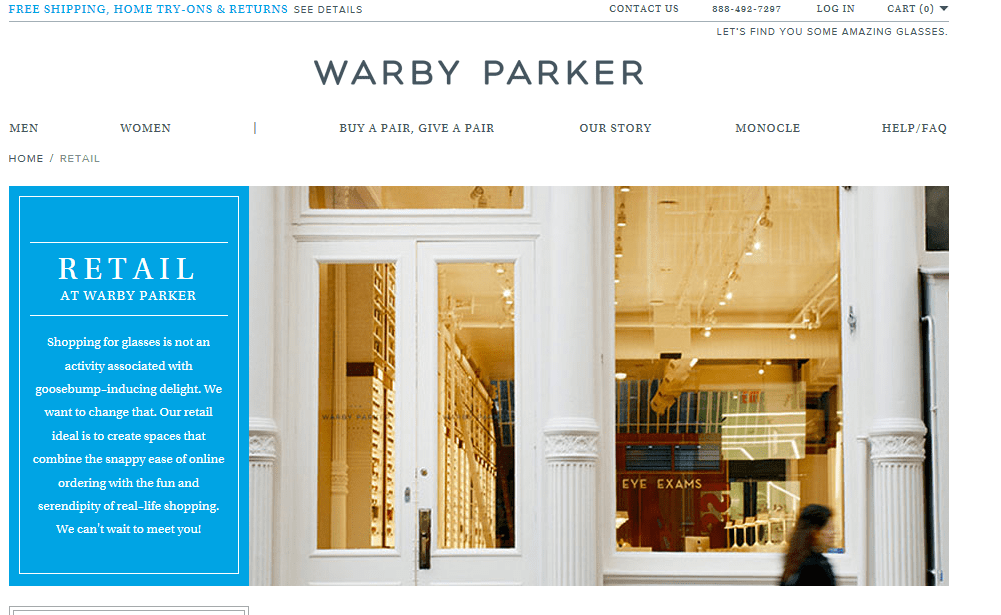
Example: These factors helped pushed Internet-based eye wear vendor Warby Parker to move from their online store to establishing physical locations using showrooms, pop-ups, and mobile trucks, and finally a permanent store front in New York. Warby Parker has joined other Internet vendors into the physical store arena – Piperlime (owned by Gap) also has a store in New York where it offers some of the clothing sold on its Web store.

The upside for vendors is that when they can get shoppers touching the product and interacting with their employees, it helps build a strong brand experience in the consumer’s mind. Companies are finding that consumers who make a first purchase in the store are likely to make future purchases online. It’s a win for the Internet and a win for the brick-and-mortar stores – giving retailers and consumers the best of both worlds.

Group Activities and Discussion Questions:

  1. Start with a discussion of online shopping vs. brick-and-mortar shopping. Have students list 10 factors that influence the location of their shopping.
  2. What are advantages of retailers that only online? Brick-and-mortar? What are disadvantages?
  3. Bring up Warby Parker’s and Piperlime’s Web site: http://www.warbyparker.com, http://www.piperlime.com.
  4. Discuss Warby Parker with students: Key message, target market, value, company strategy, pricing, etc.
  5. Divide students into teams: Have teams research online and examine other online-only businesses. What are factors that the company should consider for moving to physical locations?
  6. Have each team select an online business and develop a marketing plan for moving the business to brick-and-mortar. How can this integrate with the company’s online store?

Source:  Brandchannel.com, 5/28/13

 

Leave a comment

Filed under Classroom Activities

The Changing Shapes of Malls

2

Americans love to shop and recent trends in retail show that despite the uptick in ecommerce purchasing, shopping centers are still the buying destinations of choice for consumers. Today, shopping center are more than just a place to spend money – malls are also places that consumers go for entertainment and socializing. In a recent report, Nielsen researched trends that impact consumers’ shopping and the shopping center industry.

Lest we think that mega-malls, such as Minnesota’s Mall of America, are required to get shoppers in the door, smaller shopping centers have become lifestyle centers, mixing upscale leisure with traditional retail stores. The new lifestyle centers have found homes in predominantly urban areas such as Washington D.C., Chicago, and New York.

Nielsen found that there are several trends for sizes of stores and malls. While Wal-Mart has created supersized stores for one-stop shopping, many formerly big-box-sized retailers have downsized footprints to better meet the expectations of shoppers and provide more personalized services. Examples are Target’s City Target stores that emphasize creative design and access for urban shoppers in cities such as Chicago, Los Angeles, and Seattle.

Convenience stores are also showing strong growth. According to Nielsen, C-store growth is up nearly 5%, beating the overall market growth rate of 3.7%. Large malls also show strong growth, up 65% between 2008 and 2013, and account for nearly 7% of total malls/shopping centers in the U.S.

Let’s not forget about e-commerce shopping which has grown to approximately 5.4% of all retail sales, up from 3.5% of all sales in 2008. While this segment is growing, it still pales besides the sales at physical stores.

Group Activities and Discussion Questions:

  1. Have students review the Nielsen report “Brick by brick: State of the shopping center” – http://www.nielsen.com/us/en/reports/2013/brick-by-brick–the-state-of-the-shopping-center.html.
  2. What findings were surprising, and why?
  3. Poll students: In the past 30 days, where have they shopped – malls, convenience stores, stand-alone stores, or online?
  4. What are the driving factors pushing them to shop at those locations? What did they purchase?
  5. Divide students into teams. Have each team develop a concept for a lifestyle center or mall. What are considerations for designing these centers? (Ex: demographics trends, etc.)
  6. For the student-designed centers: what is the mix of stores and entertainment? Target market? Promotion?

Source:  Nielson.com, 5/23/13


Leave a comment

Filed under Classroom Activities

Dollar Shave Club Adds New Product Line

1

By now, many male (and female) consumers are familiar with the popular viral video for Dollar Shave Club. The humorous video has more than 10 million hits and has helped the company build a subscriber base of roughly 200,000 men who receive a new shipment of razors each month from Dollar Shave Club.

But how does an online company known for a single product line add to its success? It starts by examining the needs and wants of the target market. And, in the case of Dollar Shave Club, it sticks with a category and market it knows – personal hygiene and men.

The company surveyed 1,000 men and found that 51% of respondents admit to using wet wipes regularly, and 16% use the wipes instead of using toilet paper. Men seldom talk about using the product and 24% actually hide them in the bathroom. The survey also found that 23% of the men discreetly buy the products – and buy online. With the new product line – wet toilet wipes – Dollar Shave Club’s stated goal is to “own the bathroom and be the easiest place for men to buy the things they use every day.”

It’s a sizeable market to enter – toilet paper sales are $8.4 billion annually, which is a much larger category than the $3.6 billion annual market for razors and blades. However, for all it’s size, within the toilet paper industry, wet wipes are a niche product adopted mainly by women and children.

Enter Dollar Shave Club’s product, One Wipe Charlies. For a $4 monthly subscription addition, a package of 40 wipes can now be delivered – discretely – each month.

Group Activities and Discussion Questions:

  1. Bring up Dollar Shave Club’s Web site: www.dollarshaveclub.com
  2. Show the original video.
  3. Next, show the new video for One Wipe Charlies: https://www.dollarshaveclub.com/one-wipe-charlies
  4. Discuss the video: key message, target market, effectiveness, etc.
  5. Discuss the marketing strategy that the company uses.
  6. Using the product/market grid, discuss which strategy the company is using with the wet wipes.
  7. Divide students into teams. Have each team brainstorm on additional products that could be sold to the company’s customers.

Source:  Brandchannel.com, 6/7/13

Leave a comment

Filed under Classroom Activities