Monthly Archives: October 2012

Global Statistics Can Be Fun!

Let’s face it, unless someone is an economist or a statistician, statistics are tough to get excited about. Anyone who has ever struggled to present global statistics has experienced dread at seeing the audience’s eyes glaze over in boredom. Even the most interesting global facts about health and economics leave some people snoring. But one man, statistics guru Dr. Hans Rosling of Sweden, has a way of presenting global statistics in such a manner as to make history and statistics come to vivid life.
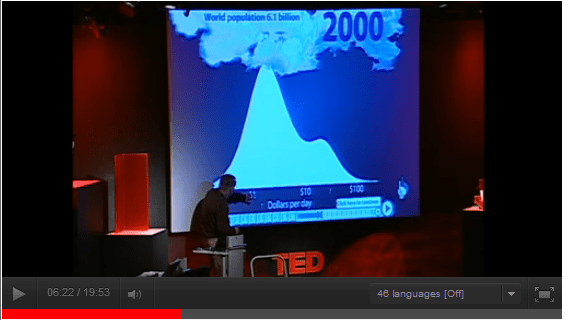
Using a unique statistical presentation and mapping program, Dr. Rosling presents global statistics in a manner that illustrates not only the differences between the Western World and the Third World, but also the ways in which countries are similar.

Group Activities and Discussion Questions:

1. Before showing the video, have students determine what they think are some of the important global factors that drive growth. What do they think are the factors which are most critical to growth?

2. Ask students to answer the first question posed by Dr. Rosling – before they see the video: Which country has the highest mortality rate of these five pairs?

  • Sri Lanka or Turkey (Answer: Turkey)
  • Poland or South Korea (Answer: Poland)
  • Malaysia or Russia (Answer: Russia)
  • Pakistan or Vietnam (Answer: Pakistan)
  • Thailand or South Africa (Answer: So. Africa)

3. Ask students: What do they think of when they think of the Western World vs. Third World nations?

4. Show the video at TED Talks

5. Note to instructors: Rosling has several other fascinating TED Talks videos that might be useful for future classes. Also check out his software program available for free use at www.gapminder.org.

Source:  http://www.ted.com/talks/lang/en/hans_rosling_shows_the_best_stats_you_ve_ever_seen.html
 

Leave a comment

Filed under Classroom Activities

Calorie Counts on Soda Machines


The rise of obesity in America has caused a rise in legislation that aims to help combat consumers’ bad habits. Already, New York City has a new law banning sodas larger than 16 ounces in most NY establishment (effective March, 2013). Other municipalities might soon follow New York’s lead. And soon, calorie counting will be practiced not just by individuals – our vending machines will also be counting (or at least easily showing) the number of calories it dispenses.

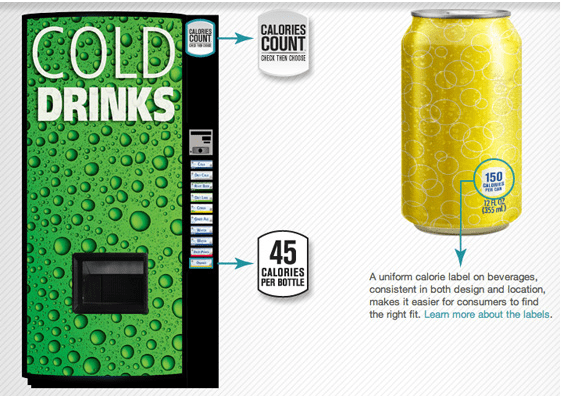
The American Beverage Association (ABA), representing the giant soda companies, is getting ready to launch a “Calorie Count” vending machine program. The program will assist consumers in easily identifying the soda calories they consume by placing the calorie counts directly on the buttons of the vending machines. According to the ABA, “the calories count vending program will offer consumers clear calorie information, encourage lower-calorie beverage choices and remind them that calories count in all the choices they make.”

The front of the vending machines will have signs that include “Check Then Choose” or “Try a Low-Calorie Beverage” and the selection buttons will include the calorie count for the beverage container. The new machines will be placed in municipal buildings in Chicago and San Antonio beginning in 2013, with a nation-wide launch following.

Group Activities and Discussion Questions:

  1. First, list students’ favorite sodas and beverages on the board. Have the students then guess how many calories are in each serving – and even how many servings are in each container.
  2. Next, have the students look up the correct calorie counts for the beverages.
  3. Alternative: Have students bring up the following Web site and take the quiz on soda sizes and calories – http://well.blogs.nytimes.com/2012/06/21/the-well-quiz-supersize-soft-drinks/
  4. Discussion groups: What are the responsibilities of beverage companies to consumers?
  5. What about other foods dispensed in vending machines?
  6. Should the same procedure be used on other vending machines?
  7. What are the marketing implications of the new laws and programs for food and beverage companies?

Source:  New York Times, Brandchannel.com, other news sources, 10/9/12

1 Comment

Filed under Classroom Activities

2012 Best Global Brands


What is a brand? Does a brand have a financial value? These are critical questions that drive the strategic marketing decisions of corporations around the world.

In general, marketers define brand as the position that a company/product holds in the minds of the consumers. It follows then that if the brand holds a position in consumers’ minds, then it would definitely translate into a financial value for companies.

Translating companies’ brands into hard dollars is a job taken on by company Interbrand. Each year, Interbrand does a financial analysis that seeks to define, in dollars, the value of a company’s brand – the result is the annual Best Global Brands ranking. In order to be included in the analysis the brand must be global – it must have successfully crossed geographic and cultural boundaries:

  • At least 30% of revenue must come from outside the brand’s home country.
  • It must have presence in at least three continents as well as broad geographic coverage in emerging markets.
  • There must be sufficient publicly available data on the brand’s financial performance.
  • Economic profit must be expected to be positive over the longer term, delivering a return above the brand’s operating and financing costs.
  • The brand must have a public profile and awareness above and beyond its own marketplace.

Interbrand’s brand valuation methodology seeks to determine, in customer and financial terms, the contribution of the brand to the company’s business results. There are three key components in the methodology for the valuations: analyses of the financial performance of the branded products or services, of the role the brand plays in the purchase decision, and of the competitive strength of the brand.

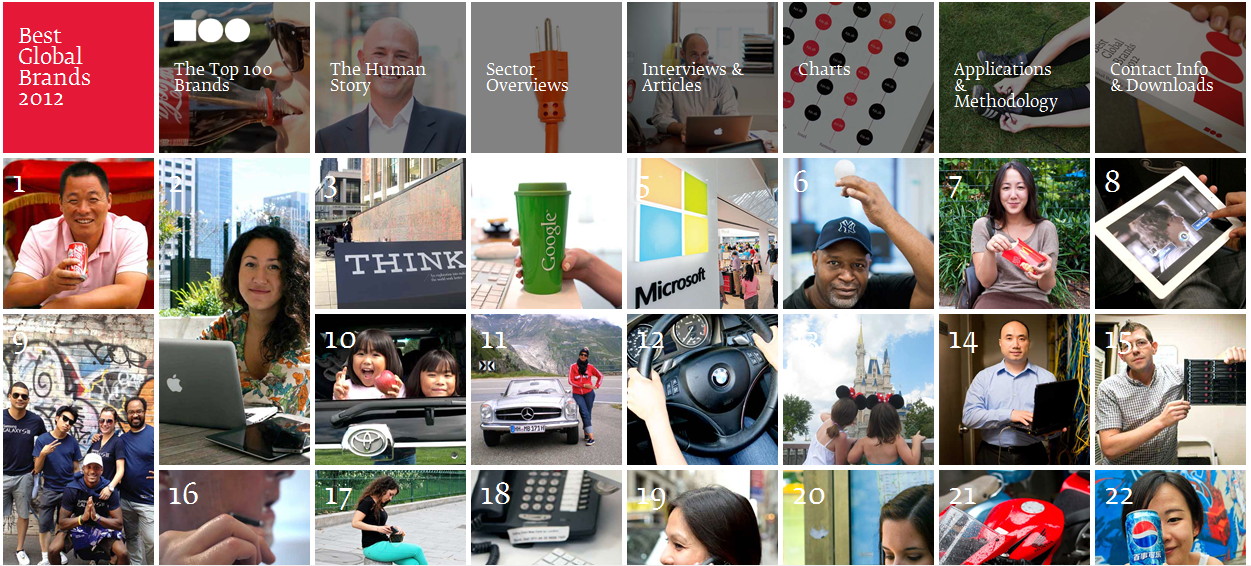
The results – well, see for yourself by viewing the interactive report at http://www.interbrand.com/en/best-global-brands/2012/Best-Global-Brands-2012.aspx. The top global brands may surprise you.

Group Activities and Discussion Questions:

  1. Ask students to define “brand.” What is it? Does it have value to a company?
  2. Have students take out a piece of paper (or write answer on laptops). Ask them to choose what they thing are the top 10 most valuable brands in the world. Then show the top 10 list from the Global Brand report.
  3. Bring up the Web site: http://www.interbrand.com/en/best-global-brands/2012/Best-Global-Brands-2012.aspx. Show students several of the sections within the site and view some of the videos as a class. Discuss the overall findings as a class.
  4. Divide students into teams and assign each team an industry category to examine: automotive, apparel, beverage, electronics, energy, etc.
  5. Have each team present key findings from the industry sector they examined.
  6. How can these findings be applied in marketing strategies?

Source:  http://www.interbrand.com/en/best-global-brands/2012/Best-Global-Brands-2012.aspx

Leave a comment

Filed under Classroom Activities