
Monthly Archives: February 2013

Garment Recycling Program at H&M Stores

3

Is your closet too full? Do you have clothing items you no longer wear or don’t fit? Do you want to do a good deed and help the planet? Look no further than the local H&M clothing store.

As part of a new fashion campaign called “Conscious Collections,” H&M has launched a global garment recycling program. H&M is the second largest clothing retailer in the world, so when it makes a statement, it does so on a global scale. The garment recycling program – available in 269 locations in the United States plus 48 international locations – will give customers vouchers worth 15% off a future purchase whenever they bring a bag of clothes to donate.

H&M has partnered with Global Green USA – the sole beneficiary of the massive recycling program. A partner company – I:Collect – will reprocess all donated garments for new use. H&M also announced the company would partner with the World Wildlife Federation on initiatives to improve the global water supply, particularly where wet processes are used in manufacturing.

Group Activities and Discussion Questions:

  1. Show the Conscious Collections video: http://youtu.be/futi8gcU79w
  2. Bring up the H&M Web site: http://www.hm.com/us/
  3. View Global Green USA’s site: http://www.globalgreen.org/
  4. View I:Collect’s site: http://www.ico-spirit.com/en/homepage/
  5. Discuss recycling programs as part of marketing programs.
  6. How does the recycling program integrate with other H&M marketing tactics?
  7. How can other companies implement similar initiatives?
  8. What is the impact of cause marketing and social issues for companies?

Source:  New York Times, Brandchannel.com, other news sources, 2/21/13
Leave a comment

Filed under Classroom Activities

February 2013 Viral Videos

2

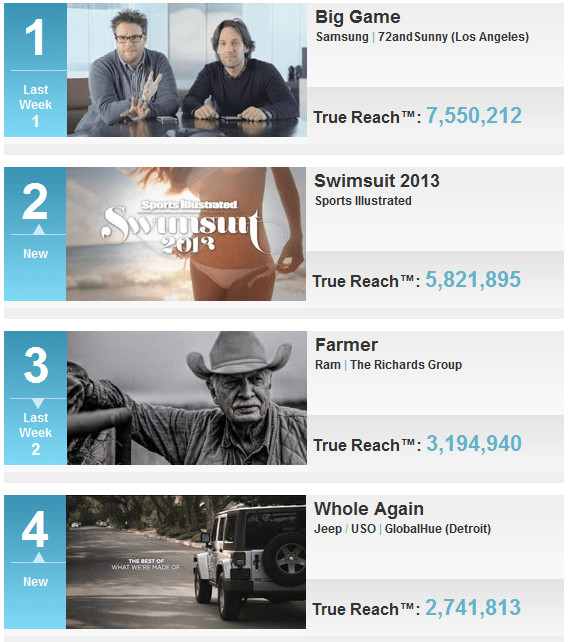
Every week Advertising Age, in conjunction with company Visible Measures, publishes a list of the week’s top performing videos. The weekly chart highlights viral video ads that appear on online video sites. Each ad measures viewership of brand-syndicated video clips as well as social video placements that are driven by viewers around the world. (A measurement called True Reach™ quantifies the total audience that has been exposed to a viral video campaign. The measurement combines data from brand-driven seeded video placements with results from community-driven viral video placements – spoofs, parodies, mashups, and more.)

There are three key factors for viral video success:

  1. Reaching the tastemakers.
  2. Building a community of participation.
  3. Creating unexpectedness in the video.


Regardless of the type of product or service, the country of origin, or the importance of the message, what matters is reaching the audience in a way the both entertains and informs.


Check out this week’s top videos and discuss what makes them “viral” – http://www.visiblemeasures.com/adage


Group Activities and Discussion Questions:


  1. Bring up Ad Age’s weekly Viral Video chart: http://www.visiblemeasures.com/adage
  2. Have students examine how the ads are measured by Visible Measures.
  3. Divide students into teams. Have each team select an ad on the top video chart and analyze the ad.
  4. What is unusual?
  5. Who will it interest?
  6. What is the key message?
  7. How effective is the ad at getting the company’s brand and message across to viewers?
  8. In teams, have students design a viral video for a product of their choosing. What are the elements that are needed to go viral?


Source:  Advertising Age, Visible Measures – weekly update


Leave a comment

Filed under Classroom Activities

Carmex and the Half-Court Hero!

1

Marketers know that the best campaigns contain various marketing tactics which are integrated for maximum exposure. Showing an advertisement is one way to gain exposure, but that is a push-feed at the consumer and doesn’t allow for any two-way interaction to build a relationship. However, adding other media such a contests and give-aways increases consumer interest and participation, as well as expands the brand’s image and exposure for a longer period.

Case in point: Carmex lip balm and personal care products. In mid-2012, Carmex launched a sweepstakes called “Be a Half-Court Hero” offering consumers a chance to win a trip to Miami to see a NBA game and make a half-court shot to win $75,000, with another $75,000 donated to a charity. A long shot, sure, but for one lucky person it was the chance of a lifetime.

Before going any further, watch the video and prepare to be amazed at the shot: http://www.nba.com/video/teams/heat/2013/01/26/Carmexhalfcourtshotwinnerjan2520-2365116/index.html

In the end, the winning shot was shown on national news channels for several days – gaining incredible exposure for Carmex, Labron James, the NBA, and Miami Heat. Challenge your students to design a similar contest and see what they come up with to meet the challenge.

Group Activities and Discussion Questions:

1.      View the company’s Web site at www.mycarmex.com.
2.      Show the video at http://www.nba.com/video/teams/heat/2013/01/26 /Carmexhalfcourtshotwinnerjan2520-2365116/index.html
3.      Divide students into teams and assign each team a product (i.e., detergent, gasoline, snack foods, etc.). Have each team design a contest or give-away that could be sponsored by a company.
4.      What are the objectives of the contest?
5.      How can the contest be integrated with various marketing tactics and social media.
6.      How would students promote the contest and the results?

Source:  Various news sources, 1/26/2013

Leave a comment

Filed under Classroom Activities