Monthly Archives: July 2012

How Social Marketing Works

There has been a lot of discussion lately about the real power of social media in marketing campaigns. Recently, General Motors pulled its Facebook advertising with the rationale that the investment did not generate significant return on investment. To counter those claims, Web analysis firm comScore, working with Facebook, released a new report: “The Power of Like2: How Social Marketing Works.” The bottom line of the report is that paid advertising on Facebook does indeed drive “behavioral lifts in purchase behavior.”

The research used data and analysis from comScore Social Essentials™, comScore AdEffx™ and Facebook’s internal analytics platform. It focused on the impact of branded earned and paid media exposure on the behavior of Facebook Fans and Friends of Fans.

Highlights from the report:

  • Brands can maximize social marketing programs by leveraging framework to move beyond Fan acquisition, to delivering reach, impact, and measurable ROI by using the Brand Page as a control panel and focusing on optimizing broader marketing objectives: Fan Reach (exposure in the news feed), Engagement (fans interacting with brand page marketing content), and Amplification (viral delivery of marketing content form Fans to Friends of Fans).
  • Most leading brands on Facebook achieve a monthly Amplification Ratio of between 0.5 and 2.0, meaning that they extend the reach of their earned media exposure of Fans to Friends of Fans by 50-200%. These ratios can be increased to improve brand reach by focusing on tactics to optimize Fan Reach and Engagement or by supplementing with paid advertising strategies.
  • Concentrated social media campaigns, such as those performed during important marketing promotions, can significantly amplify the reach of earned media exposure. Such amplification may drive increased awareness and consideration that is manifested through higher brand purchase behavior among exposed Fans and Friends of Fans.

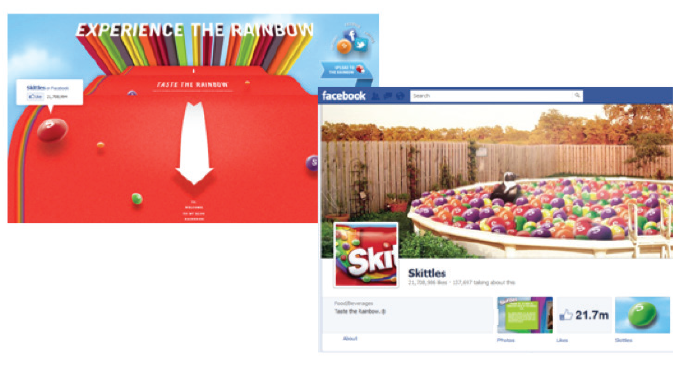
One example cited in the report was Skittles candy. While the Skittles Web site (www.skittles.com) attracted an estimated 23,000 unique visitors in March 2012, the Skittle Brand Page on Facebook (www.facebook.com/skittles) attracted 14 times as many unique visitors, generating 320,000 visitors in the same time period.
The best use of social marketing and Facebook is still evolving, but its reach to consumers cannot be denied.  Facebook does engage its users, and consumers, accounting for an estimated one of every seven minutes that users spend online.

Group Activities and Discussion Questions:

  1. Instructor can download the report from comScore at http://www.comscore.com/Press_Events/Presentations_Whitepapers/2012/The_Power_of_Like_2-How_Social_Marketing_Works (requires registration, but is quick and provides immediate access to report).
  2. Divide students into groups and have each group download the report and summarize a section to present to the class.
  3. Discuss the implications of this research for marketing on Facebook and other social media.
  4. What companies and industries would find Facebook the most beneficial to use in promotion? Why?
  5. In groups: Have students examine a product or company of their choice on Facebook. Have them do a quick analysis of the product: target market, product, pricing, channel, promotion, etc.
  6. What is the company doing right and wrong?
  7. In groups: Have students develop a revised social media marketing plan for the product they just analyzed.

Source:  Chicago Tribune, New York Times, Brandchannel.com, other news sources, 6/13/12

Leave a comment

Filed under Classroom Activities

Sponsorships on the Rise

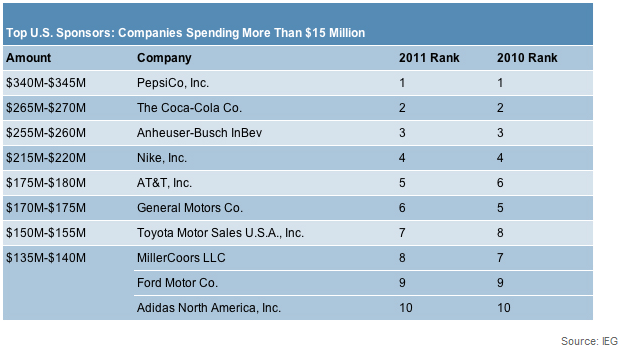
Quick – can you name the top U.S. companies that use sponsorship as a critical part of their marketing programs? If you chose soft drinks, beer, and automobiles you hit it out of the park. In 2011, PepsiCo has the largest sponsor in the U.S., spending an estimated $340 – $345 million on event sponsorships. Pepsi is flowed by Coca-Cola at $265 – $270 million, making the soft drink industry the largest user of sponsorships in marketing campaigns.

Not far behind is Anheuser-Busch in a mega deal as the official beer sponsor for the NFL, a deal costing an estimated $50 million per year for the next six years. AB’s current spending is estimated between $255 – $260 million.

According to IEG, a sponsorship research and consulting firm, the number of companies spending at least $15 million on sponsorships stands at a count of 86 firms, an increase from last year’s 77 firms. There were 44 companies that increased their sponsorship spending, and only seven companies that decreased spending.

With the Summer Olympics starting soon, look for large corporate sponsors to own the different venues. Among the official sponsors are Coca-Cola, McDonald’s, Panasonic, Proctor & Gamble, and more.


Group Activities and Discussion Questions:

  1. Discuss how sponsorships fit into the promotional mix.
  2. When are sponsorships effective, and not effective?
  3. Divide students into teams. Have them develop a list of the 10 top sponsorship companies.
  4. Have students come up with a list of the top events these companies might sponsor.
  5. Compare the student list with the article list. Discuss what makes sponsorship a good fit for these companies.
  6. In teams, have students choose a product that is not commonly thought of as an event sponsor (ex: toilet paper or baggies). Next, have students develop a sponsorship opportunity for this company.
  7. What is the target market for this product? Why does the event fit?

Source:  Ad Age Daily, 5/1/12

Leave a comment

Filed under Classroom Activities

Tweets worth noticing


With more than 250 million tweets per day, Twitter is the leading source for online communication. On average, there are 3,000 tweets generated every second. There is no doubt that for companies that want to connect with their customers, Twitter represents a great channel. But with the 250 million daily tweets, how can companies get their tweets noticed, and re-tweeted?

The strongest factor for getting attention is the source of the tweet. A strongly valued source, and quality messages, trump emotion any day. A new study from UCLA and Hewlett-Packard researched four factors and their influence on optimizing tweeted headlines and new links.

  1. The credibility of the news source generating the article
  2. The category of news the article falls under (ex: health, sports, technology)
  3. The subjectivity of the language in the article
  4. Famous people, brans, or other notable entries mentioned

The most frequently posted links were for news about technology, followed by news about health. While news about health had a lower number of published links, it had higher rates of tweets per link. Researchers also found that calm, objective language had the highest number of re-tweets; emotional language does not improve the value or the re-tweet levels.

The lesson for marketers using social media such as Twitter is similar to that of other promotional tactics – be calm, show value, be credible and trustworthy and your message will be noted.

Group Activities and Discussion Questions:

  1. Ask students what factors they look for when following or re-tweeting. Why are these factors import?
  2. Next, show the results of this new study about optimizing tweets and the four main categories: (1) Credibility of news source, (2) category of news, (3) subjectivity of language, and (4) famous people or brands mentioned.
  3. How do the students’ factors fit into the four categories? Are there any additional categories that might be useful?
  4. Divide students into groups. Have the groups identify the top categories that most interest them.
  5. Compare the students’ results on categories with the study’s categories: technology, health, and fun stuff.
  6. In teams, have students select a company they might follow and write three tweets for the company.
  7. Discuss the tweets and how these fit the categories from the study.

Source:  Brandchannel.com, 6/13/12

Leave a comment

Filed under Classroom Activities