
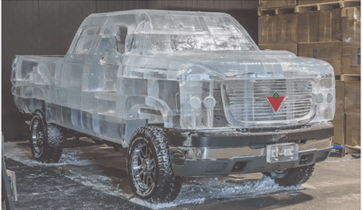
Not every product can easily show how it is different from competing products. Some products just seem to have utilitarian purposes and are less than exciting to market. For example, how does a tire company illustrate why its product is superior to another tire? Or in this case – how does a car battery stand apart from other batteries and prove that it can withstand freezing cold temperatures in the polar vortext season?
Canadian Tire, located in Ottawa, faced this issue head-on when it created an exciting, innovative marketing campaign featuring the coldest vehicle possible – a 15,000 pound truck made of ice! The company, Canada’s leading retailer of automotive goods, struggled to clearly show how its batteries excelled and to make the product exciting to consumers. The key selling point was to test, and prove, that the battery could reliably start a car in temperatures as low as minus 40 degrees Celsius. Starting with a 2005 GMC Sierra chassis, the truck frame was reinforced and welded (ice doesn’t bend); extra fans and cooling were added so that the engine wouldn’t melt the ice. The battery did indeed start and drive the car – even gaining a Guinness World record in the process. The advertisement was a resounded success, but alas, the truck eventually melted.
Group Activities and Discussion Questions:
- Show the Web site and videos: http://www.canadiantire.ca/icetruck
- Discuss the importance of developing a clear, concise message for marketing programs.
- Use a pyramid model to build the key messages: Top of pyramid – most important message that the customer wants to hear. Middle of pyramid – how the product achieves its value for the customer. Bottom of pyramid – proof points used to validate claims.
- Divide students into teams. Have each team develop a key message pyramid for the battery product.
- When debriefing the exercise, make sure to emphasize to students the difference between what a company wants to tell the market, and what a customer wants to hear about the product.
Source: New York Times, other news sources, 1/20/14