
Monthly Archives: July 2013

Smart Dog Drives Home!

7

Remember when you first learned how to drive? The feeling of accomplishment, excitement, freedom, success! Well, it might not be exactly the same feeling when a dog learns to drive, but there are still benefits. Last year in New Zealand, MINI teamed with the Auckland branch of the Society for Prevention of Cruelty to Animals (SPCA) to show people how talented and smart its dogs were by teaching three dogs how to drive! (If you are doubter, make sure to watch the video at http://youtu.be/BWAK0J8Uhzk.)

This year the campaign was expanded to give all the other non-driving-doggie-adoptees a chance to drive around in a MINI as well. All adopted puppies brought home a free MINI car made from a cardboard box. The pup gets to “drive” home in the carry box, which then transforms into a dog bed for the pup’s first eight weeks.

And, staying true to the individuality highlighted by the MINI brand, the new pet/car owners could customize their car with personalized license plate and owner’s manual. A dog’s life looks pretty good in Auckland these days.

Group Activities and Discussion Questions:

  1.  Start by showing the YouTube video of the driving dogs of Auckland. http://youtu.be/BWAK0J8Uhzk
  2. Also bring up the Facebook/driving dogs site for the project. More stories and videos are available: https://www.facebook.com/drivingdogs/app_106365926195124
  3. Why is this campaign a successful partnership between a non-profit and for-profit organization?
  4. What other partnerships might make sense for MINI? For the SCPA?
  5. Divide students into teams. Have each team select a for-profit and non-profit and develop a marketing campaign.

Source:  Ad Age Daily

Leave a comment

Filed under Classroom Activities

A Hipper Hotel for Millennials

5

The Millennial cohort is coming of age and ready to take its place in the travel market. To help them along, IKEA is partnering with Marriott Hotels to develop a new affordable hotel chain across Europe, targeted directly at the Millennial market. How is this hotel chain different from the more established hotels? According to Marriott, Moxy Hotels was designed for people with a younger sensibility with a contemporary style. The hotel was researched and crafted to reflect the changing lifestyles of the Millennial market segment.

Although IKEA is a partner in the deal, the hotel will not be using IKEA furniture. However, in traditional IKEA cost-management style, the construction costs will be managed by using rooms which are pre-fabricated offsite and then assembled in a modular type of construction (no jokes about super-sized allen wrenches!).

Moxy will open hotels in Milan, Frankfurt, Berlin, London, and other European cities. Each hotel will have 150 to 300 rooms and will be LEED-certified. Sustainability and technology features such as mobile check-in, Wi-Fi, flat-screen TV, and built-in USB ports help meet the needs of the savvy Millennial traveler.

Group Activities and Discussion Questions:

  1. Discuss with the students the Millennial market. Why is this market important to hotels?
  2. Bring up the Web site: www.moxyhotels.com and show the video.
  3. Divide students into teams. Have each team describe the target market, key message, pricing, and promotion for the hotel.
  4. What are the key considerations for attracting Millennial travelers? Are other hotel chains able to duplicate the formulat?
  5. Compare Moxy Hotels with other hotel chains: Marriott, Hilton, Holiday Inn, Country Inn, etc.
  6. Build a table comparing key components of Moxy’s design with competitors.

Source:  Brandchannel.com, Wall Street Journal, other news sources

Leave a comment

Filed under Classroom Activities

QR Codes Go Mobile!

4


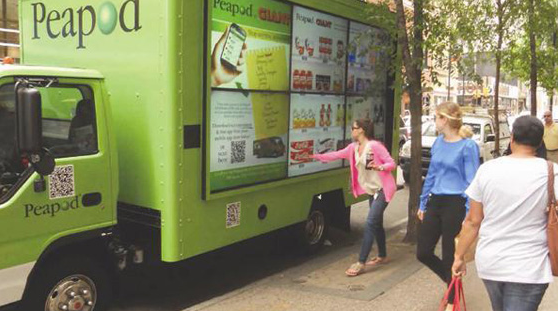
Too busy with summertime activities to go to the store? Got plans to go the ballpark or an event instead of the grocery store this weekend? Don’t stress, grocer Peapod will come to a location near you this summer.

The online grocer is using travelling billboards on the sides of its delivery trucks to reach consumers. The truck’s side panels feature QR codes that can be used to order products from vendors such as Coca-Cola, Campbell Soup, Reckitt Benckiser, and several private-label items – all while you are on your way to see a concert.

Last year, Peapod tested its ‘virtual’ grocery store concept, wrapping walls in Chicago and Philadelphia with posters of store shelves. The scan-and-shop billboards were placed in bus and train stations at more than 100 locations. The company found that the posters not only engaged the consumers, they increased orders and mobile app downloads as well. According to Supermarket News, Peapod is among the 50 larges online retailers nationwide, with $500 million in revenue, including $150 million in mobile sales.

Group Activities and Discussion Questions:

  1. Poll students about their grocery shopping habits: buying groceries online, using QR codes, grocery delivery, how engaged they are with shopping, etc.
  2. Use this information to build a model of a new grocery shopper, using online and mobile ordering.
  3. Bring up Peapod’s Web site: www.peapod.com.
  4. Divide students into teams. Have each team do an analysis of Peapod’s business: product mix, pricing, distribution, promotion, etc.
  5. Have teams develop a SWOT analysis of the company: strengths, weaknesses, opportunities, and threats.

Source:  Brandchannel.com, Supermarket News

Leave a comment

Filed under Classroom Activities