
Monthly Archives: August 2012

Branding and Sponsors at Olympics


When is a sponsorship worth the expense? While official Olympic sponsorships are limited and expensive, many other companies want to see their brands associated with the compelling 2012 London Olympic Games. Olympic sponsors pay a high price for the elite placements; sponsors have paid more than $4 billion toward the cost of organizing the events for the 204 countries represented at the Games.

To enforce the sponsors’ contracts, the International Olympic Committee has developed ‘Rule 40’ which gives Olympic organizers the right to punish – and even go so far as to disqualify – competitors if they try to promote their own sponsors, be it online (on Twitter and Facebook accounts) or on the playing field.

What’s a non-sponsoring company to do in this case?  What are some of their options for showing support and highlighting a company’s sponsorship of athletes? The lines are blurred as celebrities carry their brand loyalties and sponsorships onto the global sports stage. Take a look at some of the photos and video clips of the event and you can see logos on everything from gym bags, apparel, sunglasses, food, and headphones.

One notable marketer at this year’s Games is the U.S. Rapper, Dr. Dre. Beats by Dr. Dre Headphones are popping up in a lot of Olympic venues. An example: The Olympian with the most-ever medals, U.S. swimmer Michael Phelps, is often spotted with Dr. Dre headphones on at swim meets. And, the company has managed to outfit a number of the elite British athletes with a special Union Jack- designed Beats by Dr. Dre headphones. The guerrilla marketing campaign gave the unique headphones to a number of British athletes in London, including a goalkeeper, tennis player, diver, and swimmers. In return, a number of athletes have tweeted about the headphones; giving Dr. Dre Olympic-level visibility without the high-priced Olympic sponsor price tag.

Group Activities and Discussion Questions:

  1. Review the Olympic Web site and its approach to sponsorship.: http://www.olympic.org/sponsors
  2. What are the sponsoring companies? What are the advantages of the sponsorships?
  3. Have students pull up images and videos from the Olympic games. Check multiple sports.
  4. List the brands seen in the images.
  5. Which brands were not on the official sponsor list?
  6. Discuss how these brands got visible. What did the companies need to do?
  7. Discuss ethical and legal issues. Is what the non-sponsor companies doing ethical or legal? What about the athletes’ actions?

Source:  Associated Press,  Ad Age Daily, 8/1/12
Leave a comment

Filed under Classroom Activities

Olympic Advertising Costs

The Olympic Games is arguably one of the world’s largest promotional platform; there are more than 10,500 athletes, from 204 countries, competing in 47 events. The television and press coverage worldwide is extensive for the 10 day length of the Games.  Top-level athletes get coverage not only from their home news outlets, but from additional media worldwide.

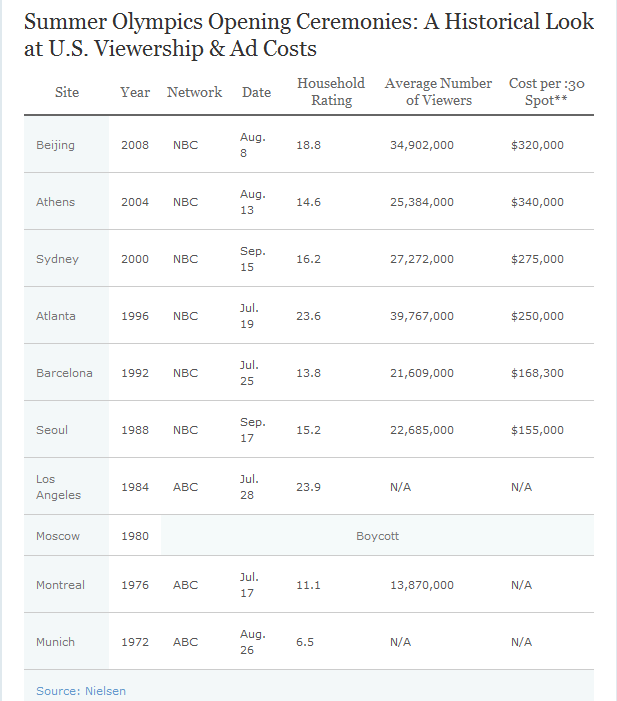
Americans view Olympic Games the most when the event is held on their own land. According to Nielsen Company, of the non-U.S.-based Games, the 2008 Beijing Games’ opening ceremonies had the top number of U.S. views with 18/8 percent of TV households, and 34.9 million viewers. This compares to the 40 million viewers for the 1996 Atlanta Games. The results are not yet in on the viewer counts for the 2012 London Games, but it should be a good result for advertisers.


Advertising costs are not cheap, but they are not necessarily as expensive as other sports events (consider the roughly $2 million price tag for 30 seconds of advertising for the Super Bowl) or popular entertainment (Sunday Night Football at $500,000).

Group Activities and Discussion Questions:

  1. Discuss the advertising advantages and disadvantages for the Olympics.
  2. View the statistics on Nielsen’s Web site: http://blog.nielsen.com/nielsenwire/media_entertainment/summer-olympics-openers-draw-big-crowds-and-advertising-dollars/
  3. Divide students into teams. Have the teams develop a list of potential target markets for Olympic events. Consider sports, countries, cultures, spending, etc.
  4. For each different target market, what companies would most benefit from advertising?
  5. Have students visit Nielsen’s Web site www.nielsen.com.
  6. What are their findings for viewership and advertising costs?
  7. How does Olympic viewership compare with other events?

Source:  Nielsen Company, 7/25/12

Leave a comment

Filed under Classroom Activities

News and YouTube


What is the relationship between citizens and news outlets? In the traditional media model, viewers only saw what the major news media outlets chose to show us. But today, news is available online, immediately after – and sometimes during – major events. And not all the content is produced by professionals; there is plenty of content filmed and posted by average people that shows their unique perspective on current events.

A recent study by Pew Research Center’s Project for Excellence in Journalism examined nearly 15 months of the most popular news videos on YouTube. Pew analyzed the types of videos, topics, who viewed, and who posted the videos. The results highlighted a new relationship between average citizens and news organizations. People create their own videos as well as share news videos produced by professional journalists.

Among the key findings were that the most population news videos are those which show natural disasters or political unrest, usually with graphic and intense videos. Average citizens play a large role in supplying video footage as well as being responsible for posting many of the videos which were originally produced by news outlets.

Group Activities and Discussion Questions:


1. Show the Pew Internet video on YouTube to begin the discussion:

http://youtu.be/SpvwpYKFzuY

Additional video:

http://youtu.be/bM6tEKid7SY

2. Discuss why YouTube is a popular place for posting and watching news videos.
3. Discuss ethical and legal issues that arise as the result of these new practices.
4. Divide students into teams. Have students view YouTube videos on the “news” channel. What types of videos are posted? What are the viewer counts?
5. Poll students: How do they learn what is happening in the world? What news shows do they watch, or read?
6. Have students search online for the latest news stories. How are the stories posted? Who posts the stories?
7. What motivates them to watch news online? On TV?
8. How could news organizations reach their generation?
9. What is needed for visuals, graphics, content, etc.
10. Divide students into groups. Have each group develop a news outlet specifically to reach college students.

Source:  Pew Internet Research, other news organizations, 7/19/12

Leave a comment

Filed under Classroom Activities